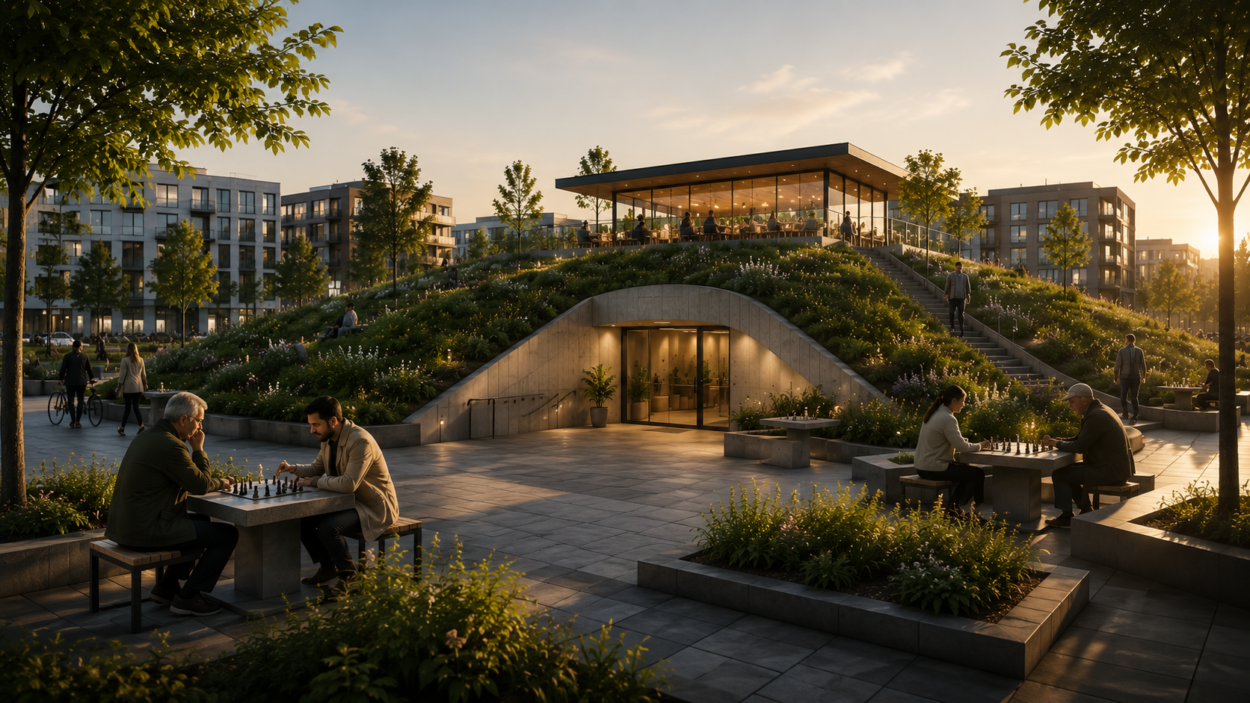
A shelter does not have to be a space that stands empty most of the time, waiting for a crisis. In a modern living environment, a bunker could instead be an invisible part of our everyday space – a place with a completely different function in peacetime, but one that can quickly be transformed into a protected space in the event of war, the threat of war, or another crisis.
The idea is simple: if a space only needs to be used in exceptional circumstances, why not give it another purpose for the rest of the time?
A shelter that doesn’t even feel like a shelter in everyday life
A good bunker or shelter does not have to mean concrete walls, an empty room, and an industrial-looking interior. With modern planning, a shelter can be integrated into the architecture of a building, garden, or public space in such a way that its presence is barely noticeable in everyday life.
It could be a playroom, hobby room, storage space, or even part of a public urban environment.
The important thing is to think of a shelter not only as a protected space, but as a space with two purposes – one for everyday use and another for situations where protection from war or another crisis is needed.
In a kindergarten, a shelter could be a playroom
One of the simplest examples is a kindergarten.
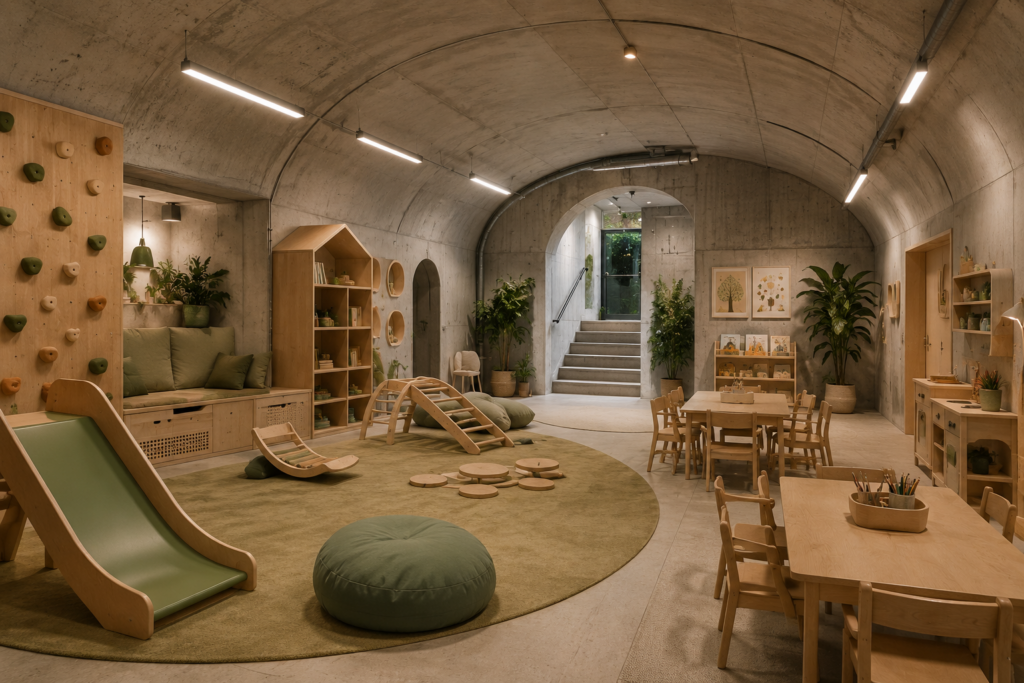
Instead of leaving a bunker empty, it could be turned into a bright and welcoming playroom. Soft mats, a reading corner, playhouses, or a creative activity area would make the space genuinely useful for children.
On the one hand, it would be a place for playing and exploring, but when necessary, the room could quickly be rearranged and used as a shelter during war or another emergency.
This kind of solution also makes the idea of a shelter feel more natural, because it is not a frightening basement, but a familiar and safe space where children already spend time in their everyday lives.
In a city, a shelter could be part of public space
But what if a shelter were not hidden at all?
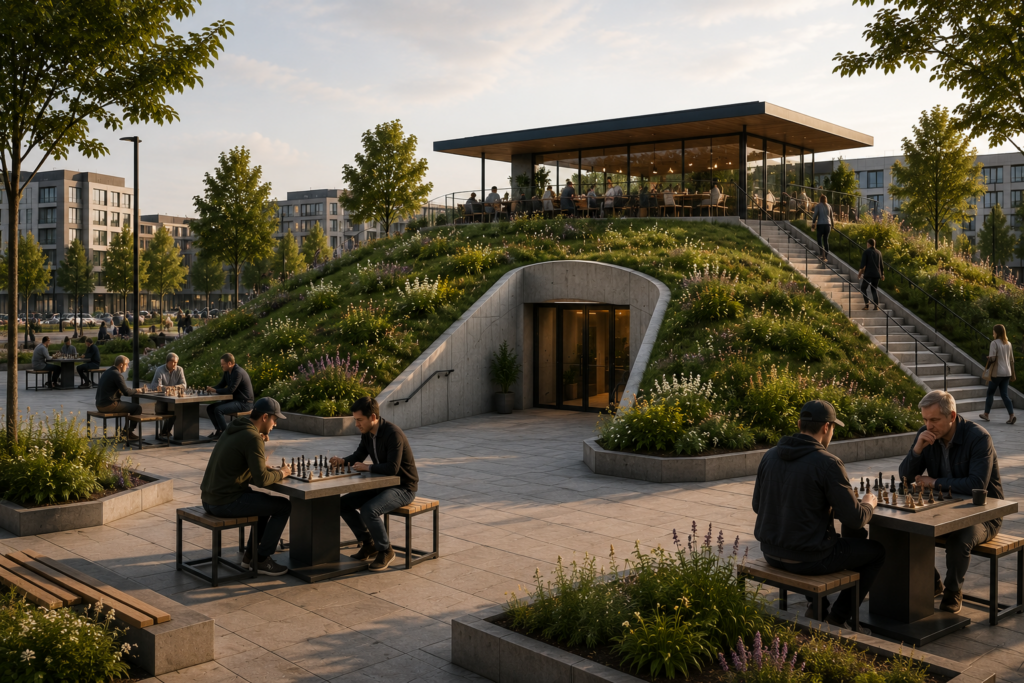
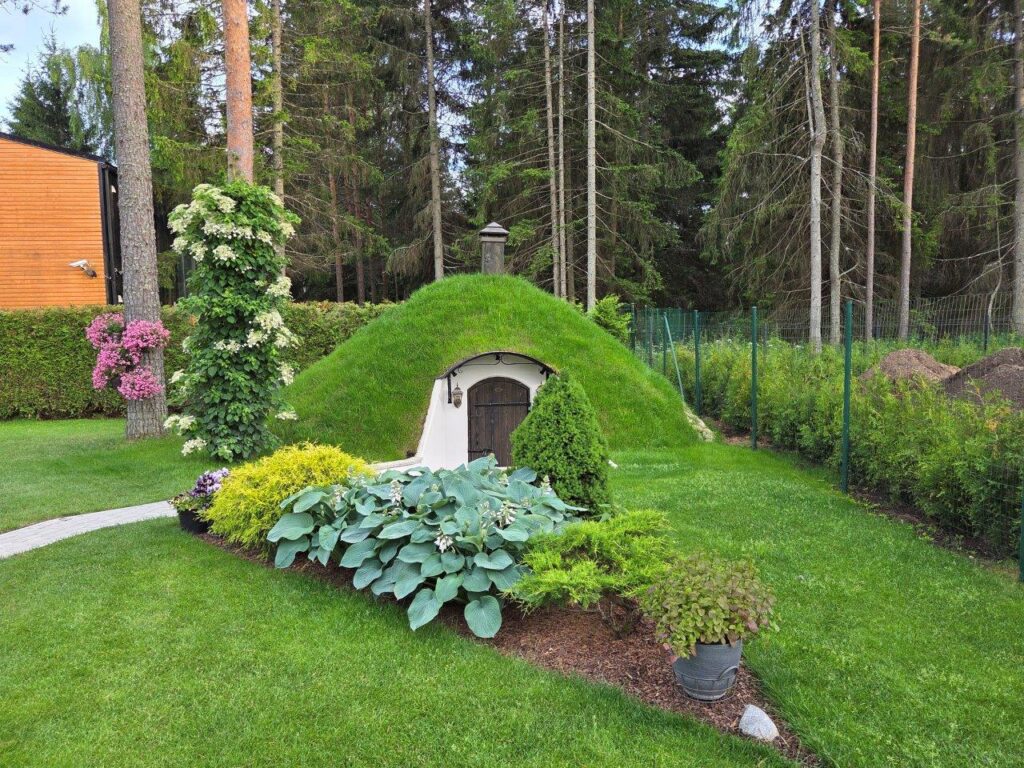
Imagine a city square with a low green hill in the middle. From above, it would simply look like part of the landscape – a place to sit, climb, or have a picnic. Inside the hill, however, there would be a shelter.
Around it, there could be a small square, chess tables, seating areas, or a playground. The entrance to the shelter would not need to look like a technical facility, but could instead be designed as an integrated part of the architecture of the outdoor space.
This creates a situation where the shelter does not take anything away from the urban environment – quite the opposite, it adds something to it.
There could be a small pavilion, café, or even restaurant on top of the hill. The shelter would be located underground, while above ground there would be a place where people can eat, meet, and spend time.
One structure could therefore serve several purposes at once: an everyday function in peacetime and a safe place of shelter in the event of a crisis or war.
A shelter can be a place to go, not just a place to hide
This way of thinking can be taken even further. An underground space could accommodate:
- a playroom or children’s area
- a gym or training room
- a hobby room
- a workspace or creative studio
- bicycle storage
- storage areas
- a sports facility
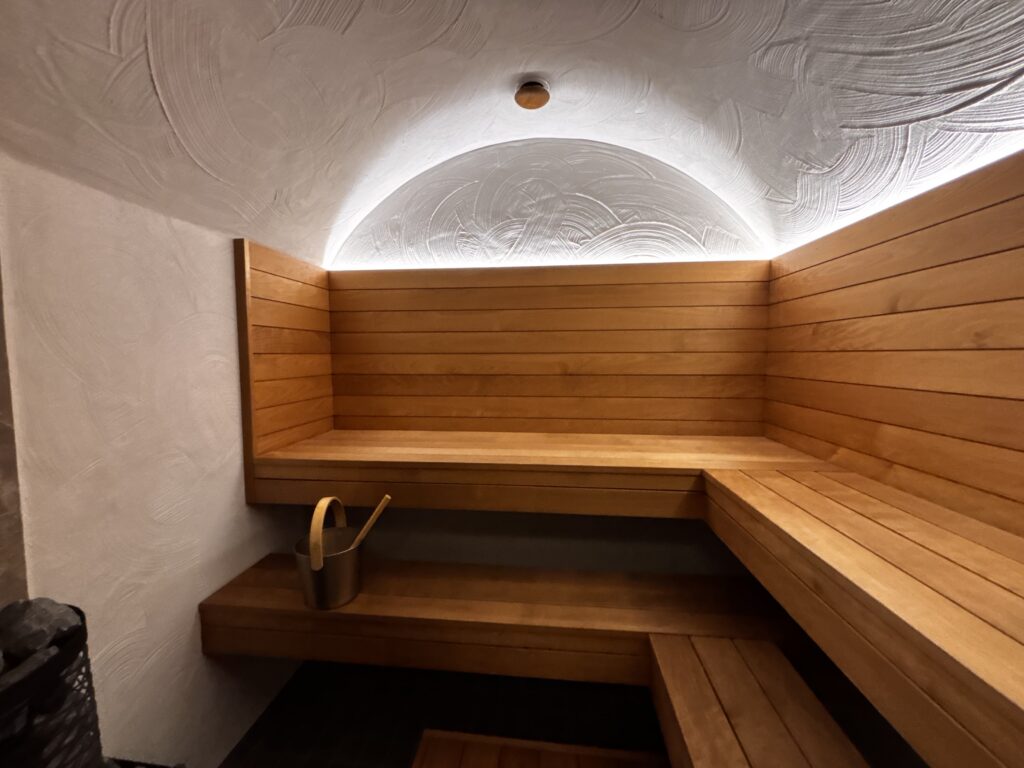
- a sauna
- a basement or practical storage space
The most interesting part is that the everyday use of a shelter does not have to be connected to emergencies at all. It can simply be part of the way we use space in our daily lives.
In Finland, an underground city is already a reality
Helsinki is perhaps the best example of this idea.
In Finland, planning underground spaces has been part of urban planning for decades. Helsinki has an extensive underground network where shelters are integrated with other city functions.
Underground spaces include parking facilities, sports facilities, play areas, swimming pools, metro stations, and other recreational spaces. According to the City of Helsinki, large shelters built into the bedrock are used under normal conditions for parking as well as sports and leisure activities.
One good example is the Itäkeskus swimming hall in Helsinki, which operates as a regular swimming pool but has been designed so that it can be used as a civil defence shelter if necessary in the event of war or another serious crisis.
Helsinki’s underground city also includes play and sports facilities. For example, the underground Play Cave in the Hakaniemi area demonstrates just how little a modern bunker needs to resemble a traditional shelter.
That is precisely the idea behind dual-purpose spaces: people do not go there to use a shelter on an ordinary day – they go there to swim, work out, play, or park.
Why not bring the same approach to Estonia?
Estonian cities and living environments are changing. At the same time, the question of how to use existing space as intelligently as possible is becoming increasingly important.
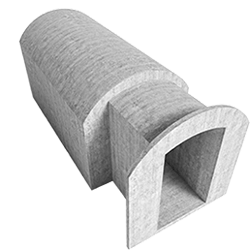
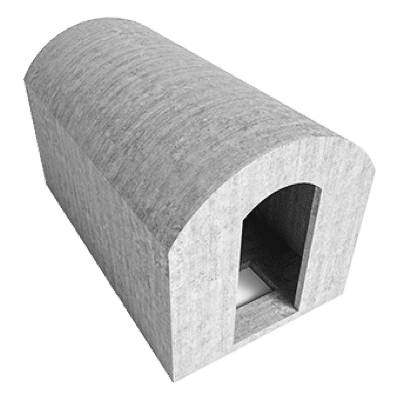
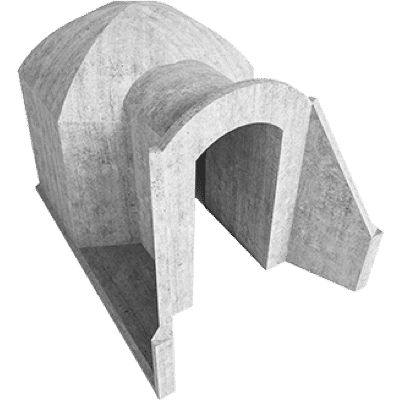
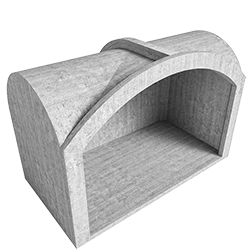
A shelter could be more than a space used only in an emergency. Compact shelters, such as 4.5 m², 11.7 m², and 16.4 m² solutions, can be planned into a variety of environments – alongside a kindergarten, apartment building, business premises, or public space.
In peacetime, a shelter can serve an entirely different purpose. It could be a practical basement or storage space for food, gardening supplies, and other essentials – but why not also use it as a hobby room, playroom, or even a sauna? This way, an underground space becomes part of the everyday living environment rather than unused space simply waiting for a crisis.
This kind of versatility gives underground space greater value. With Revonia solutions, a shelter can be approached in the same way as a basement or sauna – the space should be useful and functional in everyday life, while also being ready to fulfil its most important purpose when needed: providing protection.
Smaller 4.5 m², 11.7 m², and 16.4 m² shelter solutions make it possible to apply this approach even when space is limited. A shelter does not have to be a large underground complex. It can be a compact and thoughtfully designed part of a home, garden, or larger building.
The future of shelters does not have to be visible
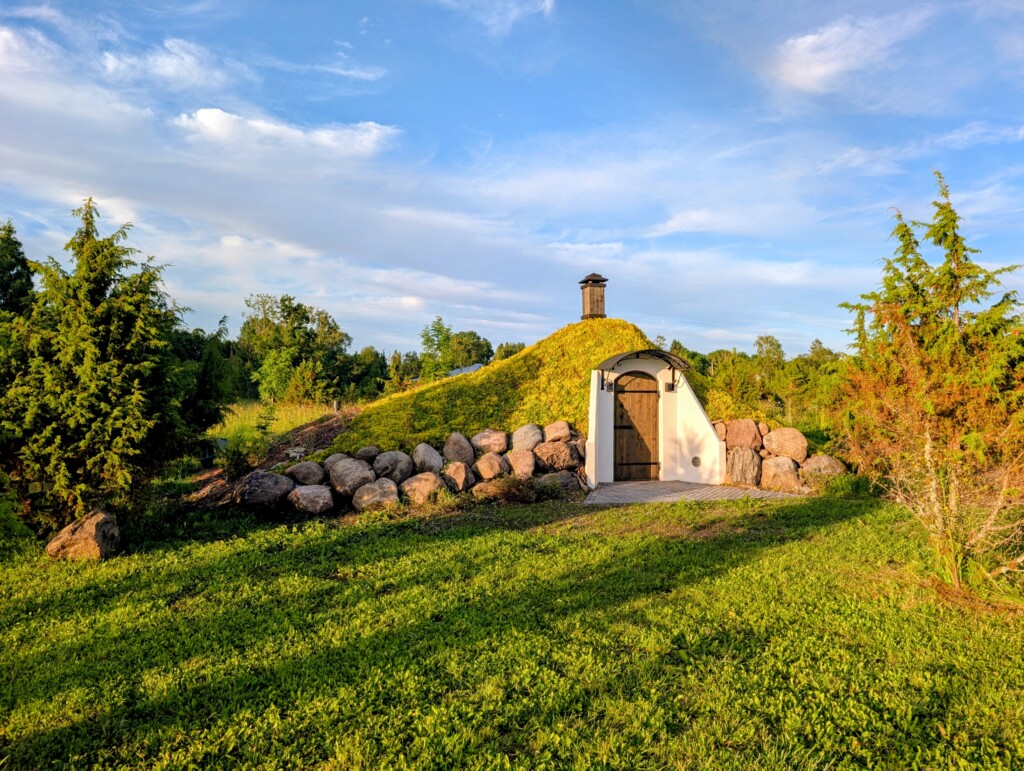
Perhaps the most interesting shelter is the one we do not even perceive as a shelter.
We do not have to build a space solely for war or crisis situations.
We can build a space that is useful to us every day while also being ready to protect us when ordinary life is disrupted.
A good shelter is a space whose existence does not need to be noticeable in everyday life, but whose value becomes especially important when it is genuinely needed.